Showing posts with label World Film Festival Bangkok. Show all posts

Friday, 12 November 2010

Ruhr - you blew my mind . . .


Or more like took it to another place as your camera's eye captured the stillness and every subtle movement together with the sound of the slightest vibration of any passing object might make. I know not much about experimental film (if anything at all), much less about the prolific James Benning but I know that each prolonged shot was for me, mesmerising; some excited me others were so still and grey such that it made me wonder what I was doing in the very cold dark theatre in the first place. What I found beautiful, and a few days later, I still have the lines implanted in my mind is the Tunnel shot which was the first of six shots in the first half of the film. A diagonal line of neon light cutting through the matte grey concrete, the slight rustling of leaves not missed, the sound of trucks and their lights piercing through captured without distraction. I could almost feel the vibrations.


The second experiment which documents the interior of a factory, the camera placed in one spot and placed their long enough to witness the dance of the machines to a beat set by man, but a dance that takes on a life of its own, glistening hot rods and the way they rolled, it was wonderful. The trees were ok, an intentional contrast to the man made perhaps, though if I am to stare at a tree, I prefer the way that Steve McQueen approached it in Giardini, with more life. The forth segment, the rubbing away of graffiti from a Richard Serra scuplture.
(how random that it should be a Serra in the middle of the Ruhr region,though I think it one of those cities like Lille or Leeds that the Govt tries to rejuvenate as art hubs).

The mosque bit was interesting, humans, particularly human behinds and the hum of the prayers. . .and the last that sent me into a slight slumber, the grey streets of Ruhr with its inhabitants. Ruhr is an industrial town in Northern Germany, what is synonymous with grey industrial towns is grey inhabitants and a lack of life, a monotony, Benning certainly captures this but I could not help but think that the factory and industry has its own rhythm and style . . .even the graffiti remover, he painted a dog - so a life of their own that is worth documenting and presenting as it is.

The second part was a coke burning factory, so a tower that blows smoke into the sky, as every ten minutes water cascades through the tower causing smoke to envelope the otherwise lifeless tower with vents, whose function is to produce coke. It was an indulgent hour, it was long, but to see the smoke take on a life of its own, an unpredictable life at that, and the tower change colours to the point that it seemed to change form and the sky surrounding it change as night descended. It was mesmerising but such that it allowed me to think about other things, for my mind to wander yet my eyes to see the spectacle before me, something which happens daily in Ruhr but to me in a dark theatre, and on a film, an exotic speciman.

I can close my eyes now and still see certain sequences where the smoke danced. I made friends with the factory and it enabled my mind to think about many other things. What is the point of art or cinema that triggers other emotions or thoughts or is not engaging enough to hold our attention? Maybe perhaps, that is the point, to endure the experience, to savour it and take that into something else, thus putting the power in the hand of the viewer to do what he wants to do. Warhol did this for 8 hours with Empire State, I am sure that in 8 hours in one's mind, great plays, scripts, songs and novels are created, but in one's mind only. The difference perhaps is if we choose to then document which the author gives to us. What is art, and what is cinema, if it is not to inspire and connect with what could be, if our minds are given the space to explore. I can close my eyes now and that smoke, those colours, their beauty, it does not change, as mundane as the subject matter was. Benning does not bully us to feel a certain way, or at least I did not feel bullied, sure the sequences was calculated, sure the sun's descent was manipulated but as far as I was concerned, this was more his meditation on Ruhr, industry on man and vice versa and I still felt free to interpret it as I wanted and I certainly know that I left Ruhr with much to think about and my mind awakened through monotony of it all.

Thursday, 11 November 2010

World Film Festival Bkk - Jacques Doillon


The honourary director at the The Nation's World Film Fest this year is Jacques Doillon. There was a little workshop at the Alliance Francaise last week, with a little discussion between him, some students and Professor Gerard Fouquet. Jacques was funny, totally passionate and extremely natural, of course he was intense in a way but his message to the film students present was pretty clear, just do it, even with a little money, it is all possible and there is no need to descend to the realm of advertising as no good will come of it, really, not in the end, and all must save and support independent film. I especially enjoyed his imitations of the little girl Victoire who played Ponette in his film of the same name during the panel discussion.

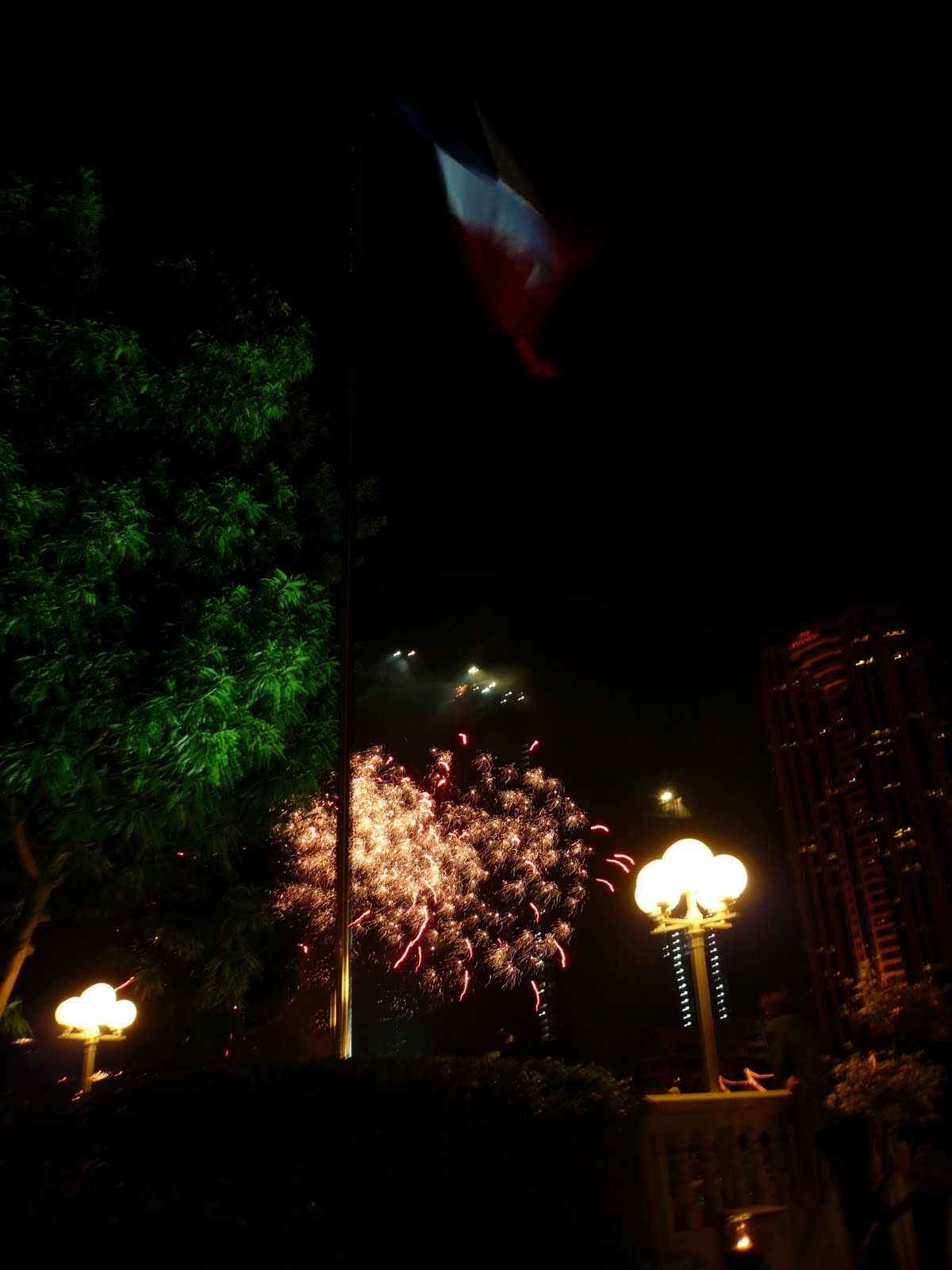
I tagged along with Lee to the French ambassador's residence for the reception for Jacques, it was lovely, especially with the cool breeze that one only experiences this time of the year. There was a wedding next door at The Oriental, a rather big wedding as there were fireworks, it was rather grand, and a wonderful coincidence that there should be a light show perhaps for Monsier Doillon at the French Ambassador's Residence. I would've liked to think so anyway.

The first film I saw of Jacques' was couple days after the reception, on Saturday, called Mariage a Trois - a film with Pascal Gregory, Julie Depardieu, Louis Carrel and this red head who was rather gorgeous with a porcelain-like face and body reminiscent of a muse in Boticelli's paintings (less voluptuous though). Sure there was a lot of talking but it was funny, ironic and at points utterly absurd, in the way that they took each other so seriously, you could almost see the characters caricatures of themselves and Jacques having fun with it. . . indulgent in parts but not in the way that it went on and on as there was always action and movement, I felt that he reflected well the utterly narcissistic, neurotic nature of all those in the film . . . a screenplay writer, actors, an intern (the redhead muse upstairs) and a producer. A cute, little satire that left me thinking - whooa . .they are crazy, but kinda sweet. It was produced by Paulo Branco (the Portugese producer who is Andre's hero), I did not know who he was last summer when Andre invited me to dinner with him, so to see his name in the credits, and also Gregory Bernard's who is also OLT's partner, the funniest guy ever - I was pleasantly surprised at the smallness of the world. The film also left me feeling rather warm and fuzzy.


I saw Ponette the day after, one of Jacques earlier films. It was really sweet, the story of a 4 year old girl Ponette dealing with the sudden loss of her mother.

She was really brilliant, the little girl and how Jacques managed to film these children and their little world, the way they spoke and how they dealt with each other. I particularly loved one scene with the little girls discussing the marital status of their parents, such precocious little things trying to figure out what "celibataire" meant. I wonder why films like this are not made any more . . . maybe because they are not so tortured and it is a bit old-fashioned, I mean, it was a simple movie about a little girl and what she was going through, though really, the concepts of life, death, god, letting go, pain/love it was all there, albeit with little children. There was a passage discussing religion and certain stereotypes thereof, I thought that if that came out of an adult one would be pretty shocked at how risque it was, but not from kids, then it's funny. So maybe presenting loss and looking at the complexity of ordeals and issues through the eyes of a child gives the film not only life but a refreshing prespective on life, loss and love. The last line, "Maman, elle m'a dit appredre d'etre contente" (Mum, she said learn to be happy) says it all really, the perfect words to the perpetually brooding child. The film gives one hope that, no matter what, it is possible to be happy after a dreadful loss and that the world is not a sphere for perpetual brooding. Thank goodness for that. See you in Paris Jacques!