Showing posts with label Jim Thompson. Show all posts

Friday, 25 February 2011

From Esarn with Love


Last weekend, Powpow and I went on a road trip to the northeast, to Pakthongchai to be exact to Eric Booth's and Waan's wedding on the Jim Thompson farm. P'Eric greeted us at the entrance, the handsome groom, looking the part in a safari suit and pa khao ma. Me in my Pa Sin pleated skirt and an updated version of a krachao top, matching crescent Corto bag and flip flops, Powpow in chinos and a sarong as belt. What all the boys wore.
What P Eric said was that this would be unique, the old Esarn way. We entered a world which I have only seen in films, of the past, of Esarn, the entire Jim Thompson family (weavers, villagers, families, staff) were out to celebrate their union. The Esarn wedding ceremony is a unique one and involves lots of dancing, a procession through the fields and the groom buying the bride with gold and cattle. Quite a sight.

dancing at the Groom's house
procession of bananas, bird cages, people

Bride and Groom at Bride's house

Friends and family were all there, everyone in casual traditional garb, Khun Yai Pasri, my inspiration looking as ravishing as usual.

Powpow
Me
P Harry, P Manit
P Rai, P Eric, P Sri

After the blessings which were songlike, we all gathered on the lawn to watch the sunset and the band play, luk thung of course to a backdrop saying Thanks Waan and Eric in Esarn dialect.

Food was delicous, drinks plentiful, P Rai and P Sri have their very handsome boys very well trained to fill up our makeshift ice bucket. Luk Thung and Molam. . .speeches, including one in Esarn by Eric's father, a touching moment by the bride and more music. It was like stepping into an Apichatpong film, perhaps Syndromes and a Century, with the lights, the stage, the music. It was a big village ceremony and party, 1000 people dancing.


Powpow and I left after some time for the long roadtrip home and as we we entered Bangkok, we realised that we had stepped into another world. We felt rejuvenated and very happy for the cutest couple ever and hugged by the simple romance of it all.


Congratulations Waan and P'Eric. xxx

Thursday, 13 January 2011

Art Farming

When one thinks of a farm, one does not often expect to see perfectly kept fields of sunflowers, polite and demure buffalos, a miniature Esarn village and lastly, an exposition by artists, left to their own devices on the farm to leave behind installations for vistors to see. Then again, not every farm is a Jim Thompson farm and not many companies are Jim Thompson. We drove 4 hours (should have been 3 but our driver insisted on taking the longer, windier scenic route - yes, we got lost) from Bangkok and were to meet P'Jeab Grithiya at the big pumpkin. There was a big pumpkin at the entrance, and a perfect photo opp for the many Thai visitors who were there that day. It had a touch of Disneyland, especially as it was the weekend of National Children's Day, but it did not for a second feel that it was driven by a corporation. The day before there were a total of 6000 visitors and P'Jeab mentioned that on that particular Sunday we might have hit 5000 or so.

In any case, Doy, Pette and I had the best guide ever, P'Jeab did after all, initiate the Art on Farm project and curated the artists that were on the sight. The first curiosity were the little trams themselves, I think we went on the Eggplant tram, they were made by hand by a university professor who works also on the farm and from objet trouve. Too chic. I loved the pink strawberry and the brown one with the painted horse's bum. As we oohed and ahh'ed at the first sunflowers, I was as distracted by the little ducks on the ceiling of the tram that were also rather cute. The sunflower fields were just a taster as the girl with the megaphone who expertly memorised not only Jim Thompson's story but also information about Art on Farm, how it came about, the idea of community art and how the artists came up with their work.


The first installation was of turned over "flowers", giant silk turned over flowers that looked like oversized sombreros, from the air they would dhave been giant flowers. Upon closer inspection they were made of left over silk threads and silk bits, what is found on the factory floor and the artist picked these up to create her own work. Colourful giants, that nature did not ignore as in some parts grass grew through the brightly coloured strands.

P Jeab explained that the artists who were from all parts of Thailand were let loose on the farm and in the silk factory, to get to know the region, to learn about silk and where it comes from and I guess to an extent get back to nature somehow. It was rather fascinating the different interpretations, the context infused with their own background and the medium they chose to communicate through.

The pumpkins were less an art installation than a whole lot of fun. I felt like Dorothy. . .

Then we came across a huge field of cosmos flowers and at the end was a little garden with the brightest pink flowers ever. As you ascend upon the garden you realise that they are not real, it is a fake garden, a manicured garden with a real bronze but fake bamboo bench in the middle of a living flowers. here the artist juxtoposes the manicured garden of real and fake plants in the vast fields of real delicate pink flowers, that do have an expiry date. Visually beautiful, and begs the question as to what is real and fake and their co-existence. Does it matter, if the fake ensures that beauty can last forever? As the plants shed their leaves, their plastic partners will remain, though might fade a little with time.

Then we get to the first Esarn house, what a beautiful house. "Simple Esarn people" as they are known to city folk have mastered the art of using directing windflow for ventilation and temperature control, so as to regularise how much wind flows through and keeps their wooden stilted houses cool, in most cases from the cracks in the floors. The wind coming through the floor cracks enables them to keep their windows very small to protect their daughters' dignity (or the family's whichever way one wants to look at it, there is no Romeo action possible in those neighbour hoods). The artist in the house was Kornkrit Jiandipinan, a site-specific work that felt very ,modern, very now, as he juxtaposed pictures of local people and created a nostalgic (not corny) collage of their lives.

He came across hammocks and was particularly taken by the image of the solider on a hammock that part of the installation he created a rest area for visitors below the house with many hammocks.

hammocks on the ground
Boonlun the buffalo

farm lunch where convo centred around food and the the statement "Korat is where it's at!"

After a lunch of Esarn food . . .we continued our tour. I was especially impressed with the use of objet trouve where bits and pieces which would otherwise be worth very little was converted into meaningful items. I believe this is what value-added creation is about, ingenuity into value. To me the little greeen chairs is not rocket science but do have design value in itself. The little stools were made by the resident-architect. I would totally buy them for the house.

The next installation was about sound, by a young artist from the region. She wrote a book of dialogue in the Esarn dialect and in the dimly lit room were lamps made of traditional woven shades but decorated with strips of leftover silk. Again, creating something visually pleasing and interesting in the most simple way. The room was adorned with sound, messages from mother to daughter. A room of talking voices recorded in little silk dolls that floated around. She asks you to engage in the floating dialogue by recording your own contribution in the dolls. It was fun but at the same time mysterious as you hear voices in thin air something which creates a rather haunting quality, sounds in space from strangers speaking a foreign dialect that sounds familiar and like "home" but is not.


What I also rather liked is how these works, which are rather conceptual and derived from a thought process by the artists still allowed the kids and their grandmas and grandpas enjoy being there. It was inclusive, if you did not like the art you could appreciate the other bits and acknowledge that art can be part of your existence, that it has its role too and is accessible. The musical grandpas, the mini free Isan film festival, the little pogo sticks and wooden carts, the silk demo station. There is consent to becoming part of the community when one enters the farm, it is not passive as the activities ask you to engage and enjoy. I really think that there was something for everyone, even the most jaded and cynical.


My favourite piece on the farm was by a young artist called prachaya phinthong, from Ubonratchathani. It was very clever but at the same time so simple and to me captured something which feels futuristic as recordings of radio shows heard in his hometown ran on a loop and was projected into space where the speakers were stuck in a tree that stands at the end of a bridge in the lake thus pentrating through air, time and space. It created what to me felt like a vacuum in time as one stands on the bridge and listens to the radio, totally out of context but merging sounds of esarn with the reality of standing a bridge over the water. You are invited to engage again by speaking into the microphone, your voice forming another layer over the recording. I found the single microphone in an empty white room itself rather futuristic, a single instrument in space. A great example of a site specific work.


Another piece which was immaculate was the room with "beds" of cocoon and dead mulberry leaves. The artist who is also a designer took so much care and was absolutely meticulous in the way that he presented the life of the silk worm. You are invited to lie on a bed of wired racks where below lies a bed of dead mulberries leaves and on top of silk cocoons white and yellow in a woven habitat - it is here where they grow. The artists used black plastic piping as a way to reuse the material which was available. As a viewer, one is literally alive between the dead and almost dead. Next you are invited to literally go into a cocoon as the small lower room which would have been used to keep mulberry leaves when the factory was still in use became a cave of silk strands. A bit spooky, kind of alien like. In the last part in the adjoining room, you are then invited to lie down on the floor on pillows to watch a projection of images of nature, the world surrounding the silk worm perhaps. Probably the most work intensive of the installations, a work that requires more time to sit and engage and explore a singular world of the silk worm.


The last of the installations was by Montri, breaking out of the cocoon. The installation of labyrinth created from old silk looms and ricea nd silk was first at Jim Thompson house. I found the work to be much stronger in its urban sitting, the contrast more interesting. It felt almost too much at home here where as at the art centre it felt foreign and more menacing. What was very effective though was the barbed wire of books and rice grains in the low room. That worked as the barbed wire dips underground creating another dimension to the work.


Alas, the actual artists residences. Next winter this will become a tiny little boutique resort, all concrete in the jungle in a kind of Soviet manner. Minimalist bliss bunker ex-silk factory. Can't wait.

Of course, any visit to a farm in Thailand needs a shopping area to make it all complete, the museum shop if you like. Here the "museum shop" is the farm's factory outlet so JT silk products, bits from the Art on Farm including limited edition tiffin bento boxes by Kan the artist, little microphone dolls and the Farm Shop. I bought a purple chill tree (that now has one or two bright red chillis) and pumpkins. I had no idea how many different types of pumpkins there were! We liked the bar coded mini squash.


The sunset over the farm as the day came to an end was quite surreal.

Despite being stuck in Sunday night traffic back home, all I remember thinking the next day was, "please take me back to the farm".

I like it there - a lot.

Art on Farm

is located at the Jim Thompson farm in Pakthongchai, Korat. The Project along with teh Jim Thompson Farm Tour and the Isan Film Festival has been extended till April 13th, 2011, WEEKENDS only . . .HURRAYYY

Wednesday, 17 November 2010

Revisiting the Jim Thompson Era. . .

and immersing oneself in the intrigue of the years immediately after World War II and indeed a rather tumultuous time in Thailand's political, cultural and artistic landscape through a selection of headlines from the Bangkok Post, old footage, a movie (House on the Klong) and a fantasy bazaar in 2010, is only possible at the home of the man himself. Jim Thompson disappeared in 1968 but his legacy lives on. I had a personal tour by the expert of the subject and supreme curator P'Jeab or Grithiya Gaweewong herself, after hours.

She walked me through the carefully curated headlines that adorn the walls, sometimes with footage and sound clips from the National Film Archive creating a collage with moving images and sound taking you back into time . . . here are some of my faves . . . though the Twist is light, the context is much gloomier.

The never ending battles today with censorship, freedom of expression, double standards and a whole lot of other issues.
Sean Connery's visit in 1966 was not a secret (love this pic)

To journey back to the 50's and 60's is to witness the fact that Jim Thompson got his hands into everything, a renaissance man by any standard, even the most cynical and he truly immersed his own self with passion and unrelentless energy in his various endeavours, the perpetual host who could not "bear to be alone" and he obviously had great taste. His disappareance haunts people to this day, though the old movie from 8 years after his disappearance shed some light on his story, the man himself and the mystery. It was spooky and give me goosebumps at sevaral moments, defo film noir influence and talk about not holding back on the Hitchcock moments with that music. My first question after the film faded into black was "What happened???" P'Jeab told me to read the book . . .and I will read it, we all like a bit of intrigue but his is different, he became famous, infamous and along with him so did Thai silk (though silk is just the surface and the beginning, his legacy goes beyond that, and might I add that Thailand is not just about silk and beauty, it is far more complex). A true insider, and if Jim was still alive today, he would be 104.


Michael Shaowanasai's Bazaar, his homage to the era that combines his own methods, energy and vibrancy to the hope after the War, where after destruction there was creation and a power struggle of which we, as country was smack in the middle of, mere witness, victim or beneficiary depends on what side you are on.

New ideas, new horizons, the Dior New Look, Space, the red scare and the cold war. The items on sale unde the label Oriental Silk Sewcity (or OSS - the organisation Jim Thompson belonged to during war time, the precursor to the CIA) Nagara's couture creations sitting a long side these remnants of a time-past reinterpreted, at one level kitsch and fun, at another making a statement regarding the past, and what it took for us to arrive to where we are today. Though one does have to wonder. . . what much has changed, especially as plans for our new airport were announced in 1962 (this is a news clipping on the wall).

Then again, all was informed by context and references, there needed to be a new look after the war, the old order had been destroyed, is it possible for us to thrive ignoring what is around us?

The homage to him and his era sheds light on what we are today and begs the question as to how and why are we still trying to answer the same questions and are still in the dark.

A worthwhile visit that deserves some time to get to know a lost legend and the context in which he lived and our country and her politics, the latter something, which we cannot seem to escape from too far today and which if we look closely, is more relevant than ever.

Revisiting the Jim Thompson Era
will be at the Jim Thompson Art Centre until January 15th, 2011.
The Centre is open from 9 am - 5 pm every day.

Wednesday, 2 December 2009

Golden Tiger/Hidden Monkey

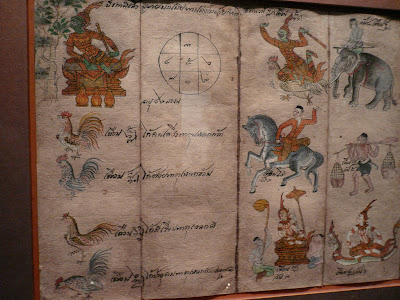
I found myself on Monday night, once more at the Jim Thompson House for the opening of Golden Tiger/Hidden Monkey.  The show was described on the invitation as "astrology * art * life * dialogue with Jim Thompson Art Collection".  It was a big affair, not surprising as it is a group show made up of artists with a rather strong following.  In this case, Roj Singhakul of Issue and Pattree Bhakdibutr of Erb . . .along with Kamol Phaosavasdi, Wisut Pooonimit, and Bhubawit Kritpholnara.  The show touches all senses and definitely spoke to astrology, life and art. .  . not a surprise when the Jim Thompson collection includes classical drawings of the 12 animal signs from the early Rattanakosin period (early 19th century).  Well preserved and beautiful, a strong part the show and a good reference point.  

antique drawing of the Rooster

The artists were commissioned to interpret astrology, which if one thinks about it widely - is about life - especially as each sign defines a certain personage and fate.  Patree created a scent for each sign. E.g. Piyatat is a Dragon, his scent was woodier, more wholesome, it was ginger.  I am a Rooster and the scent which defines me is mint with lavender, lighter, more fleeting.  Now, an Erb x Jim Thompson collection of scents for each sign could be so cool . . .
Piyatat

There is even a forest installation that glows with the sounds of the jungle and animals resonating in the darkness, must come back for an astrology reading.

And the models, preserved in a glass box, each look representing a sign, P'Roj referencing again literally his concept/brief, but wow, was it a stunner and oh so effective.  
installation

Even wearable in parts, if one thinks about how the silk was draped, or the very cool patterned leggings.  

fabric (dog)

rooster

alive rooster

Let's hope that we get to see a Roj x Jim Thompson silk collection in the near future. . .I would love a set of silk square pillow cases, one for each sign or a light silk sarong of the roosters stars, and its celestial companions the snake, dragon and horse.  The models then walked around the projection and then it was all about the projection itself.  The cartoons were super-cute, so innocent yet secretly complex . . .I liked the race, esp the little girl who starts the race (this piece tells you the story of how the signs put in order and which signs are compatible/incompatible) and the third piece, with the dancing.  Music was played live by the artist himself on a keyboard - genius.  Loved it.

rat at finish line first

Cleo and Nat


As always, it being P'Eric's venue, it was nice to catch up with friends and enjoy the most delicious Thai food.  This time I walked away with a little book that interprets the stars and gives feng shui advice for the year of the golden tiger and hidden monkey which starts on the 4th February 2010.  

Golden Tiger/Hidden Monkey 
will at the Jim Thompson House, Bangkok 
until Feb 2010